Abstract
References
Sorry, not available.
Click the PDF button.
Information
This study analyzed the determinants of residential electricity efficiency in Korea where the importance of electricity demand management in households is increasing. According to empirical analysis result, the increase in income or the decline in the electricity price leads to the inefficiency of residential electricity consumption. Also, as the number of elderly households increases or the number of households residing in apartments increases, the household electricity efficiency improves. On the other hand, the increase in one-person households was found to have a negative effect on the electricity efficiency improvement. It is confirmed that the increase of cooling demand has a little effect on residential electricity efficiency, but the increase in heating demand results in deterioration of residential electricity efficiency. Therefore, improving the efficiency of both heating equipment and residential buildings heating means helping to improve the electricity efficiency of total households. Also, it implies that the policy to improve electricity efficiency should be further strengthened for non-apartment housing.
본 연구는 전력수요관리에서 그 중요성이 증가하고 있는 가정의 전력소비효율에 대한 결정요인을 분석하였다. 국내 도시 가구의 전력소비효율에 대한 결정요인을 연도별로 실증분석한 결과, 소득 증가와 전력가격 하락은 전력소비효율 악화로 나타났다. 그리고 고령가구가 증가하고, 아파트에 거주하는 가구가 늘어날수록 전력소비효율은 높아지는 것으로 나타났다. 반면, 1인 가구의 증가는 전력소비효율 개선에 부정적인 영향을 주는 것으로 분석되었다. 냉방수요의 증가가 전력소비효율에 미치는 영향은 통계적으로 유의하지 않지만, 난방수요의 증가는 전력소비효율을 악화하는 결과로 이어진다는 것을 확인하였다. 다시 말해, 난방수요를 전력에 의존하는 전기화 현상은 전력소비효율을 낮추는 요인으로 작용한다. 그러므로 난방기기 효율과 함께 주거건물의 난방효율 개선이 전력소비효율을 높이는 데 도움이 될 것이다. 또한, 아파트 외 주거형태가 전력소비효율을 낮추는 주요 요인이므로 아파트가 아닌 주거지에 대해서 전력소비효율을 높인다면, 전체 가정의 전력소비효율을 개선하는데 크게 도움이 될 것이다.
Click the PDF button.
- Publisher :Korea Energy Economic Institute·Korea Resource Economics Association
- Publisher(Ko) :에너지경제연구원·한국자원경제학회
- Journal Title :Korean Energy Economic Review
- Journal Title(Ko) :에너지경제연구
- Volume : 17
- No :2
- Pages :147-181
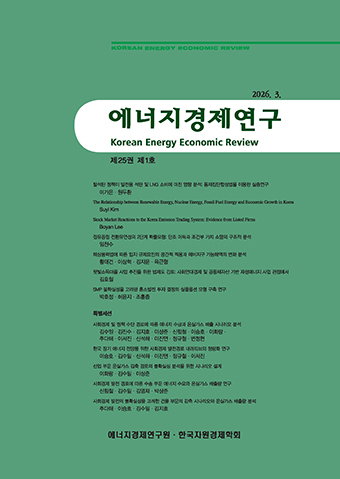 Korean Energy Economic Review