-
Research Article
-
The Relationship between Paid Allocation Ratio and Firm’s Energy & Carbon Intensity: Evidence from the Korean Emissions Trading Scheme
상장기업의 유상할당 비율변화와 기업의 에너지 및 탄소집약도 간의 관계: 국내 배출권거래제를 중심으로
-
Oh Hyeon Son, Donggyu Yi
손오현, 이동규
- This study analyzes the relationship between the paid allocation ratio and the energy and carbon intensity of listed companies under the Korean …
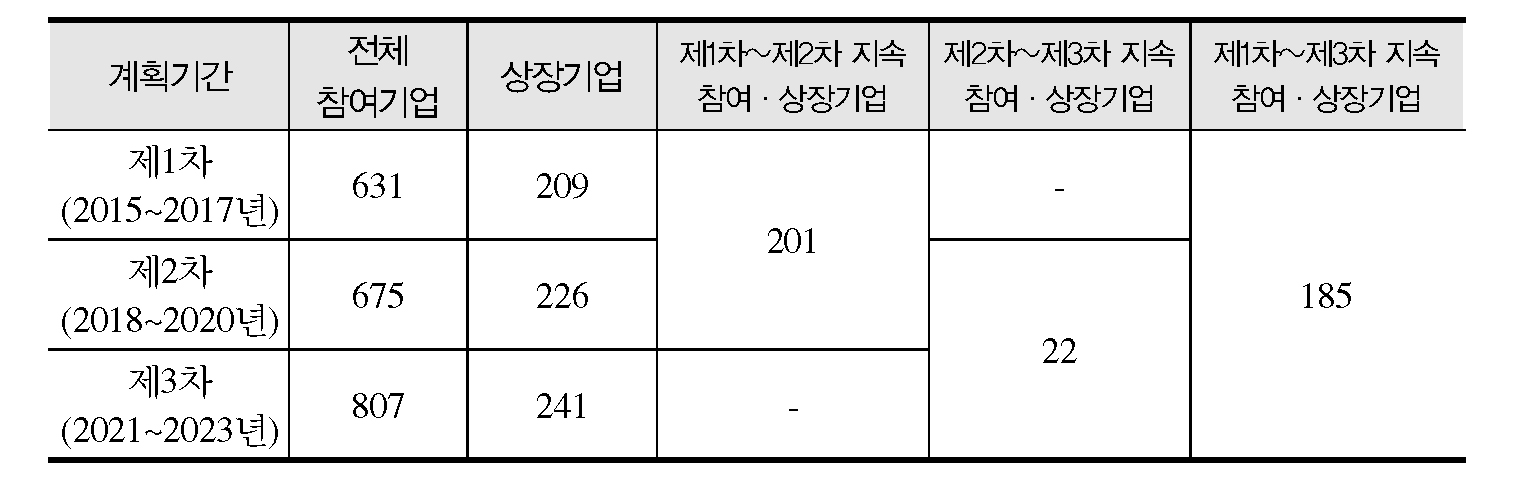
본 연구는 국내 배출권거래제에서 유상할당 비율과 기업의 에너지 및 탄소집약도 간의 관계에 대하여 분석하였다. 이를 위해 할당기업 중 상장기업에 대한 미시데이터를 구축하고 …
- This study analyzes the relationship between the paid allocation ratio and the energy and carbon intensity of listed companies under the Korean Emissions Trading Scheme (K-ETS). Using a panel two way fixed effects model, the analysis reveals that a 1%p increase in the paid allocation ratio was associated with an average 1.5–1.8% rise in intensity. This trend was primarily driven by firms participating since the first phase of K-ETS. For firms joining in the second phase, the coefficient was negative but lacked statistical significance. Overall, no evidence suggests that the paid allocation ratio improves intensity in the short term (within five years). These results imply that managing the total emission cap, rather than the allocation method, may better incentivize corporate investment in emission reductions.
- COLLAPSE
본 연구는 국내 배출권거래제에서 유상할당 비율과 기업의 에너지 및 탄소집약도 간의 관계에 대하여 분석하였다. 이를 위해 할당기업 중 상장기업에 대한 미시데이터를 구축하고 패널 이원고정효과 모형으로 실증분석하였다. 분석 결과, 상장기업들은 유상할당 비율이 1%p 증가함에 따라 에너지 및 탄소집약도는 평균적으로 1.5~1.8% 증가하였던 것으로 나타났다. 이러한 효과는 제1차 계획기간부터 참여한 할당업체들에 의해 주도되었다. 제2차 계획기간부터 참여한 할당업체의 경우, 유상할당 비율의 계수가 음수로 추정되었으나 통계적인 유의성을 가지지 못하였다. 다만, 해당 상장기업들은 관측치가 충분하지 않아 향후 추가적으로 데이터가 축적된 후의 확인이 필요해 보인다. 종합할 때, 최소한 5년 이내의 단기적으로는 유상할당 비율이 상장기업의 에너지 혹은 탄소집약도를 개선시킨다는 증거는 찾을 수 없었다. 이러한 결과와 선행연구를 연결시킨다면 유상할당보다는 배출허용총량의 관리가 기업의 온실가스 배출감축에 대한 투자유인을 부여할 것으로 기대된다.
-
The Relationship between Paid Allocation Ratio and Firm’s Energy & Carbon Intensity: Evidence from the Korean Emissions Trading Scheme
-
Research Article
-
Energy Price Shocks and Firm Exit: Evidence from Korean Manufacturing
에너지 가격 충격과 기업 퇴출: 한국 제조업 기업을 중심으로
-
Da Gyeong Yoo, Doo Hwan Won
유다경, 원두환
- This study examines the impact of energy price shocks on firm exit risk using panel data on externally audited manufacturing firms in …
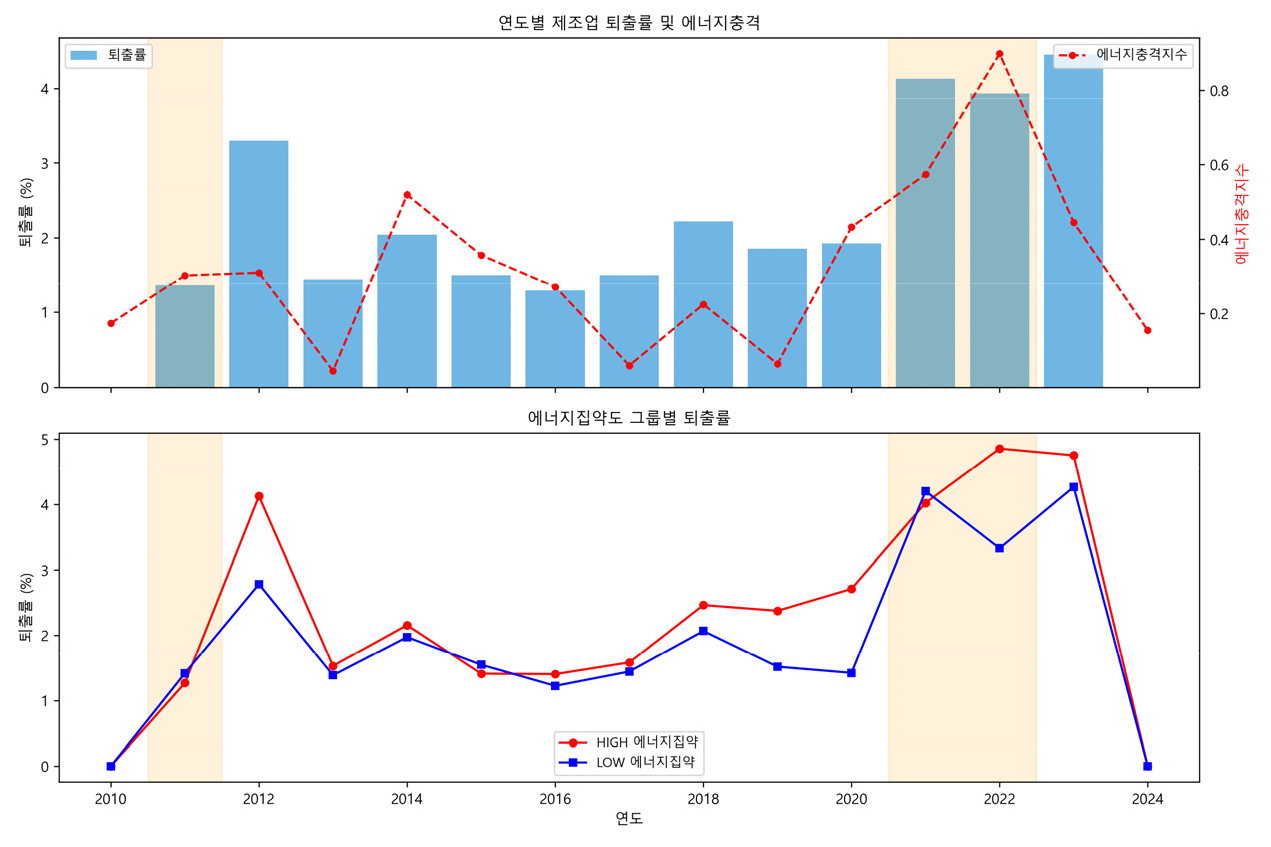
본 연구는 2010~2024년 한국 제조업 외감법인 패널자료를 이용하여 에너지 가격 충격이 기업 퇴출 위험에 미치는 영향을 분석한다. 시간 가변 계수를 허용하는 Time-varying …
- This study examines the impact of energy price shocks on firm exit risk using panel data on externally audited manufacturing firms in Korea from 2010 to 2024. A Time-varying Cox model that allows for time-varying coefficients is employed to estimate heterogeneous effects of energy price shocks across firm characteristics. The results show that the effect of energy price shocks varies significantly depending on firm characteristics. In particular, increases in energy price volatility tend to raise the exit risk of small firms more strongly than that of larger firms. In addition, borrowing dependency increases exit risk, while operating profitability reduces it, indicating that financial soundness plays an important role in firm survival. These findings suggest that energy price shocks do not affect all firms uniformly but operate differently depending on firm size and financial structure. The results highlight the need for targeted policy responses focusing on vulnerable firms during periods of energy price volatility.
- COLLAPSE
본 연구는 2010~2024년 한국 제조업 외감법인 패널자료를 이용하여 에너지 가격 충격이 기업 퇴출 위험에 미치는 영향을 분석한다. 시간 가변 계수를 허용하는 Time-varying Cox 모형을 추정한 결과, 에너지 가격 변동성 충격은 중소기업의 퇴출 위험을 대기업에 비해 유의하게 더 크게 높이는 것으로 나타났다, 이러한 격차는 차입금 의존도가 높은 재무적 취약 기업에서 더욱 두드러진다. 즉 에너지 가격 변동성 충격은 독립적으로 작동하기보다 기업의 규모 열위와 재무적 취약성을 매개로 퇴출 위험을 증가시키는 방식으로 작용한다는 것을 의미한다. 이러한 결과는 에너지 가격 충격이 모든 기업에 동일하게 작용하기보다 기업 규모와 재무 구조에 따라 차별적으로 작용함을 보여주며, 에너지 가격 변동기에 취약 기업을 중심으로 한 선별적 정책 대응의 필요성을 시사한다.
-
Energy Price Shocks and Firm Exit: Evidence from Korean Manufacturing
-
Research Article
-
Price and Output Elasticities of Energy Demand in Manufacturing: A Comparison with All Industries in OECD Countries
제조업 에너지 수요의 가격 및 산출 탄력성 추정: OECD 국가를 대상으로
-
Sung Jin Kang, Yun Ho Jin, Sijun Cho
강성진, 진윤호, 조시준
- This study estimates the energy demand elasticities of price and output for the total industry, the manufacturing sector, and the light and …
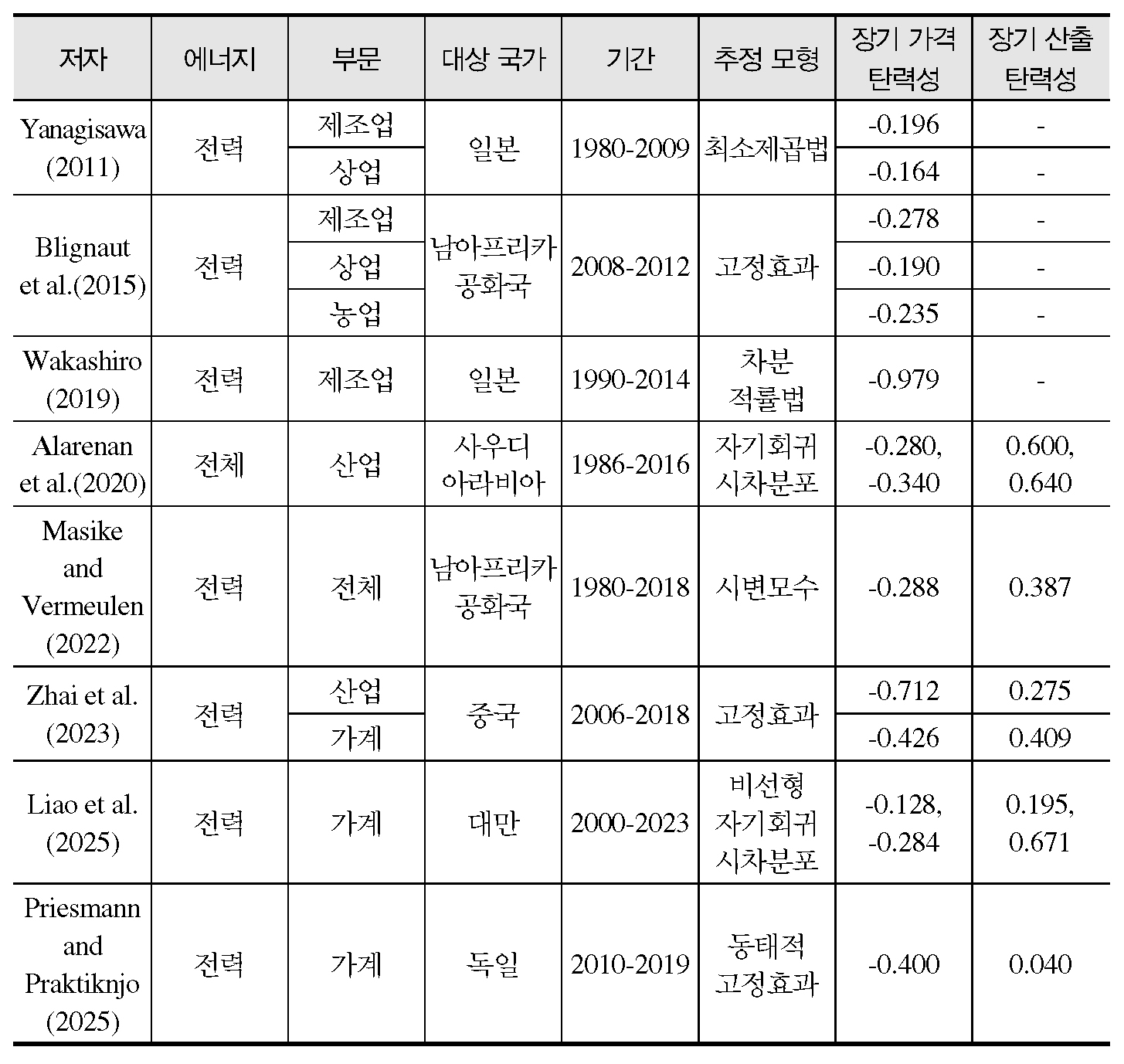
본 연구는 1993년부터 2022년까지 OECD 36개국의 패널 자료를 바탕으로 동태적 패널 시스템 적률법(Dynamic Panel System GMM)을 이용해 전체 산업과 제조업 그리고 제조업 …
- This study estimates the energy demand elasticities of price and output for the total industry, the manufacturing sector, and the light and heavy industries within manufacturing. Utilizing a dynamic panel system generalized method of moments (GMM) estimator and panel data from 36 OECD countries spanning 1993 to 2022, the analysis provides a comprehensive overview of energy consumption patterns. Given that manufacturing is highly energy-intensive, research on this sector has gained significance amid the transition toward carbon neutrality and increasing energy supply chain instability. To this end, the study compares the elasticities of the manufacturing sector with those of the total industry and conducts a granular analysis of light and heavy industries. The main findings are, first, that the manufacturing sector is more elastic than the total industry in terms of both long-run price and output. Second, within the manufacturing sector, the light industry is found to be more sensitive to price and output changes than the heavy industry. These findings are attributable to specific industrial characteristics and highlight structural differences in energy demand across sub-sectors, providing empirical evidence for the design of differentiated energy policies.
- COLLAPSE
본 연구는 1993년부터 2022년까지 OECD 36개국의 패널 자료를 바탕으로 동태적 패널 시스템 적률법(Dynamic Panel System GMM)을 이용해 전체 산업과 제조업 그리고 제조업 내 경공업과 중공업의 에너지 수요에 대한 에너지 가격과 산출 탄력성을 추정하였다. 제조업은 에너지 집약도가 높은 산업이며, 탄소 중립, 에너지 공급망 불안 등 여건의 변화로 인해 에너지 소비 연구는 더욱 중요해지고 있다. 이를 위해 제조업의 에너지 가격과 산출 탄력성을 추정하고, 전체 산업의 탄력성과 비교하였다. 또한, 제조업의 세부적인 에너지 수요 분석을 위해 경공업과 중공업에 대한 탄력성도 추정 및 비교 분석하였다. 연구 결과, 전체 산업과 제조업 간 비교 시 장기 가격 탄력성과 산출 탄력성 모두 제조업이 더 탄력적인 것으로 나타났으며, 경공업과 중공업 간에는 경공업이 중공업보다 가격 및 산출 탄력성이 더 민감한 것으로 추정되었다. 이 같은 결과는 제조업의 산업적 특성에 기인하며, 제조업 내에서도 세부 산업에 따른 에너지 수요의 구조적 차이를 시사한다.
-
Price and Output Elasticities of Energy Demand in Manufacturing: A Comparison with All Industries in OECD Countries
-
Research Article
-
Oil Price Shocks and the Operating Profit Margin of Korean Listed Firms: Effects of Oil Price Increases and Decreases and the Role of Cost Structure
유가 충격이 한국 상장기업 영업이익률에 미치는 영향: 상승·하락 효과와 비용구조의 역할
-
Jaeeun Shin, Hongjun Yoon
신재은, 윤홍준
- This study constructs a quarterly financial panel of 781 Korean listed firms for 2017–2024 and estimates the main models using a common …
본 연구는 2017년부터 2024년까지 한국 상장기업 781개의 분기별 재무 패널을 구축하고, 유가 충격 측정 방식 간 공통 회귀표본인 2018년부터 2024년까지의 자료를 이용하여 …
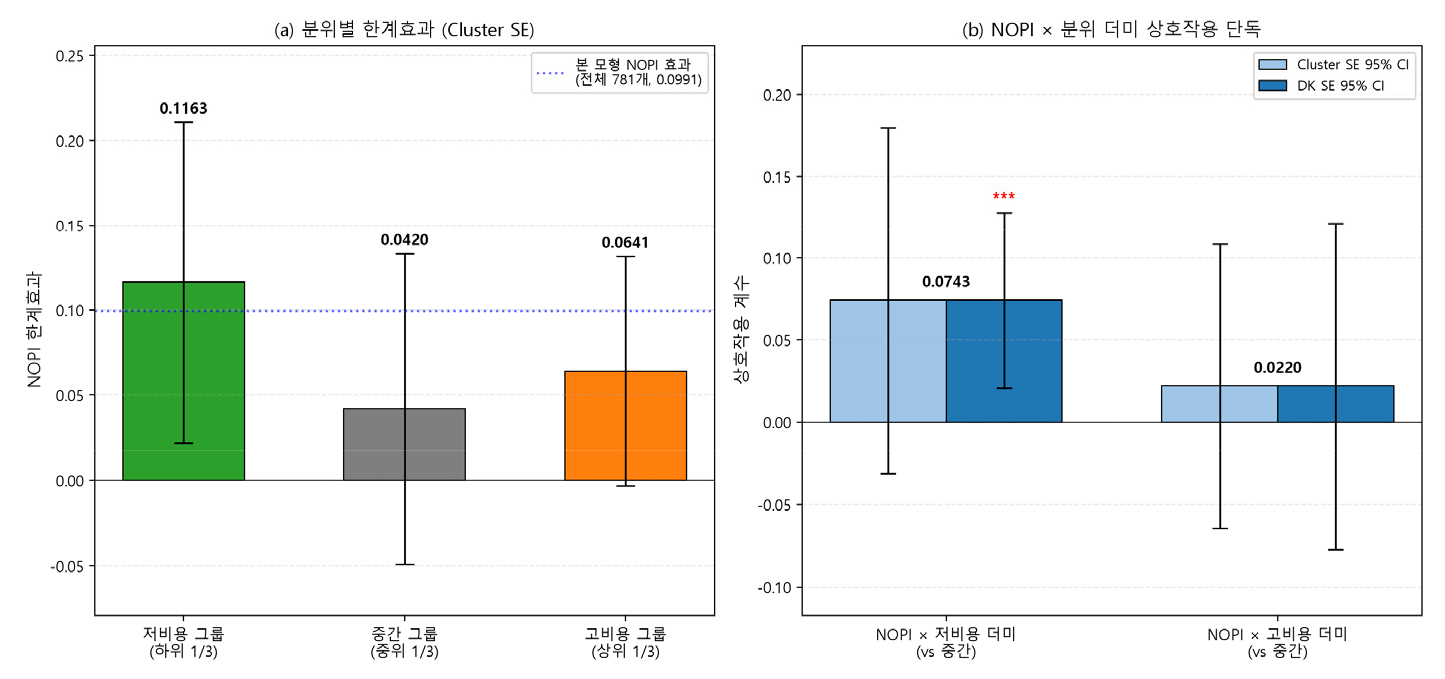
- This study constructs a quarterly financial panel of 781 Korean listed firms for 2017–2024 and estimates the main models using a common regression sample for 2018–2024. Mork’s asymmetric decomposition shows that both oil price increases and decreases are positively associated with operating profit margins, while their coefficient difference is not statistically significant. Cost-structure analysis identifies a significant response only among firms with low cost exposure, providing insufficient evidence of a monotonic or nonlinear relationship across exposure levels. A joint test also indicates that oil-shock coefficients differ across industries, although individual industry patterns remain descriptive. By using a pre-sample average cost ratio, this study reduces the mechanical link between contemporaneous costs and profitability. The estimated results do not directly identify the underlying demand or cost-transmission mechanisms.
- COLLAPSE
본 연구는 2017년부터 2024년까지 한국 상장기업 781개의 분기별 재무 패널을 구축하고, 유가 충격 측정 방식 간 공통 회귀표본인 2018년부터 2024년까지의 자료를 이용하여 유가 충격과 기업 영업이익률 간의 관계 및 이질성을 분석하였다. Mork 비대칭 분해를 적용한 결과, 유가 상승분과 하락분은 모두 영업이익률과 유의한 양(+)의 관계를 보였다. 다만 상승분과 하락분의 계수 차이는 통계적으로 유의하지 않아, 충격 방향에 따른 비대칭성은 분석 기간에 뚜렷하게 확인되지 않았다. 비용구조 분석에서는 비용노출도가 낮은 기업의 NOPI 한계효과가 통계적으로 유의하였으나, 중간 및 고비용 그룹의 한계효과는 영(0)과 명확하게 구분되지 않았다. 따라서 비용노출도에 따른 단조적 또는 비선형적 관계를 확정하기는 어렵다. 산업 통합모형에서는 산업 간 유가 충격 계수의 차이가 공동으로 유의하였으나, 개별 산업에서 관찰된 계수 패턴은 사후적이고 기술적인 결과로 해석할 필요가 있다. 본 연구는 분석 기간 이전의 평균 원가율을 시간불변 비용노출도 지표로 활용함으로써, 동시기 비용구조와 영업이익률 사이의 회계적 연동 문제를 완화하였다는 점에서 의의가 있다.
-
Oil Price Shocks and the Operating Profit Margin of Korean Listed Firms: Effects of Oil Price Increases and Decreases and the Role of Cost Structure
-
Research Article
-
Portfolio Analysis of Hydrogen Supply Considering the Cost–Risk Trade-off between Domestic Green Hydrogen and Imported Hydrogen
국내 그린수소와 수입수소의 비용-리스크 균형을 고려한 수소 공급 포트폴리오 분석
-
Kiyong Jung, Sam Youl Lee
정기용, 이삼열
- Korea has established a 2050 carbon neutrality scenario in which renewable energy is expected to play a central role, yet studies on …
한국은 기후위기 대응을 위해 2050 탄소중립 시나리오를 수립하였다. 이를 달성하기 위해 신재생에너지의 역할은 중요하지만 그 공급구조에 관한 연구는 부족한 상황이다. 본 연구는 …
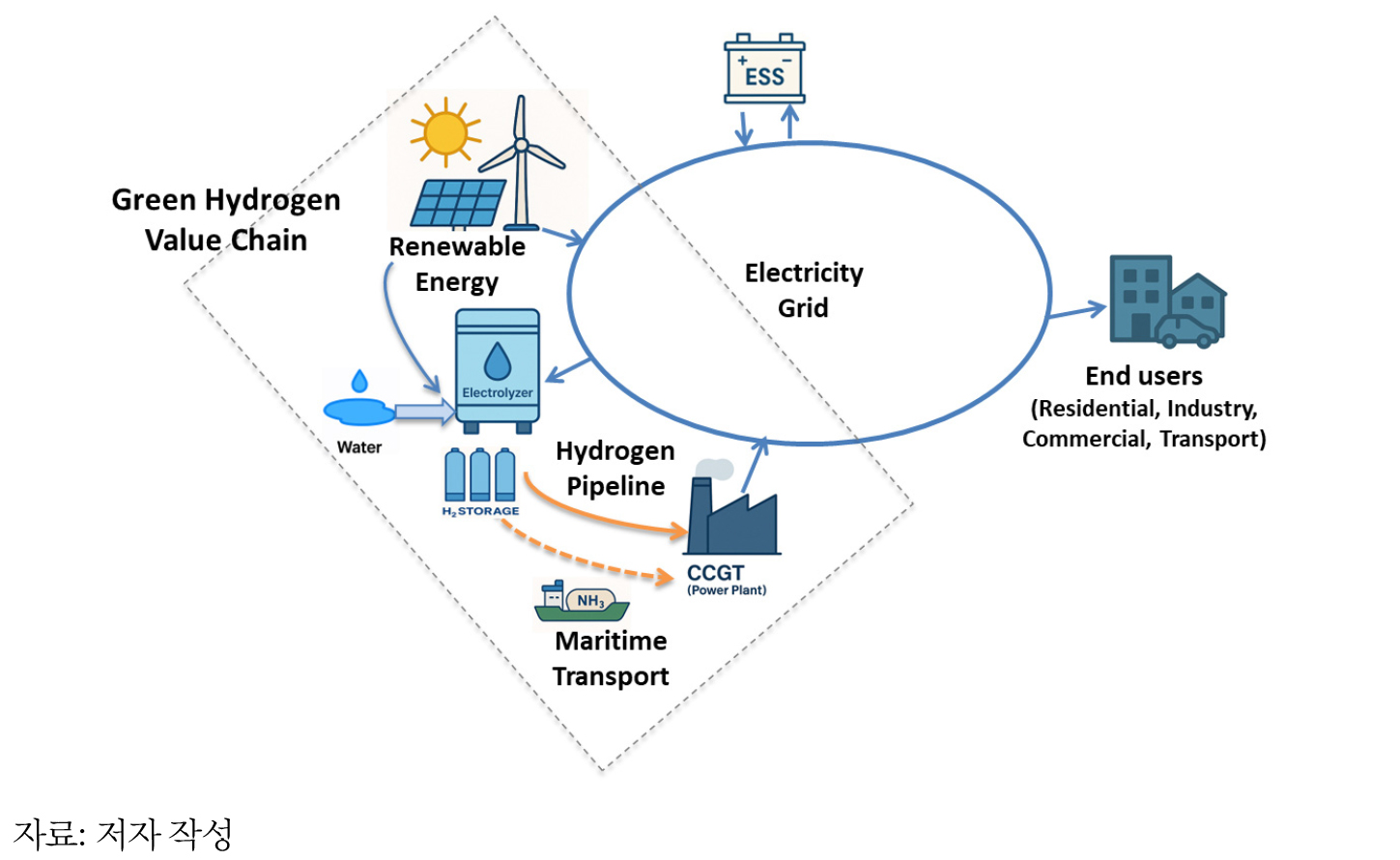
- Korea has established a 2050 carbon neutrality scenario in which renewable energy is expected to play a central role, yet studies on its optimal supply structure remain limited. This study proposes a transition scenario replacing conventional power generation with a system centered on renewable energy and green hydrogen–based power generation. While domestic green hydrogen is less cost-competitive, imported hydrogen is structurally exposed to global price fluctuations and geopolitical risks. To address this trade-off, a mean–variance portfolio framework is used to analyze the cost–risk relationship between domestic and imported hydrogen. The results show that a mixed supply structure achieves greater cost reductions for a given level of risk than reliance on a single source. Furthermore, an optimal hydrogen procurement portfolio exists when both economic efficiency and supply stability are jointly considered. These findings highlight the need to move beyond a single cost metric and adopt an integrated perspective that accounts for both cost and risk at the system level. From a national perspective, domestic green hydrogen—despite its relatively higher cost—can be a policy-relevant option when both economic efficiency and energy security are considered.
- COLLAPSE
한국은 기후위기 대응을 위해 2050 탄소중립 시나리오를 수립하였다. 이를 달성하기 위해 신재생에너지의 역할은 중요하지만 그 공급구조에 관한 연구는 부족한 상황이다. 본 연구는 기존 화력발전을 재생에너지와 그린수소 기반 무탄소 가스터빈 중심으로 전환하는 시나리오를 제시하고 그 타당성을 분석한다. 국내 그린수소는 원가경쟁력 측면에서 해외 그린수소 대비 열위를 보이지만, 해외 도입 수소는 국제 에너지 가격, 지정학적 리스크 등 외생적 요인에 구조적으로 노출되어 있다. 이에 본 연구는 두 공급원을 대상으로 평균-분산 기반 포트폴리오 분석을 활용하여 비용-변동성 상충관계를 분석하였다. 분석 결과, 단일 공급원에 의존하는 방식보다 국내 생산과 해외 도입을 혼합한 공급구조가 동일한 위험 수준 대비 더 큰 비용 절감을 달성할 수 있으며, 에너지 수급의 안정성과 경제성을 균형 있게 고려하는 공급 포트폴리오가 존재함을 확인하였다. 이는 탄소중립을 위한 에너지 시스템 구축 시 단순한 비용 지표에 국한하기보다 전체 에너지 시스템 차원에서 비용-위험 구조를 함께 고려하는 분석 관점이 필요함을 시사한다. 나아가 국가적 관점에서 경제성과 공급 안정성을 동시에 고려할 경우 원가가 상대적으로 높은 국내 그린수소도 정책적으로 타당한 선택이 될 수 있음을 뒷받침한다.
-
Portfolio Analysis of Hydrogen Supply Considering the Cost–Risk Trade-off between Domestic Green Hydrogen and Imported Hydrogen
-
Research Article
-
Price Level, Price Risk, and the Cost of Equity: Evidence from the Marketisation of China’s Coal-Power Tariff
전력가격 수준과 가격위험, 그리고 자기자본비용: 중국 석탄화력 기준전가 시장화의 증거
-
WenJie Zhao, Hyoung-Goo Kang
조문걸, 강형구
- On 12 October 2021 China’s National Development and Reform Commission widened the permitted trading band around the provincial coal-power benchmark tariff, abolished …
2021년 10월 12일 중국 국가발전개혁위원회는 성(省)별 석탄화력 기준전가(基準電價)를 중심으로 한 거래 허용범위를 확대하고, 산업용·상업용 목록전가를 폐지하였으며, 에너지다소비 사용자에 대해서는 상한 규제를 면제하였다. …
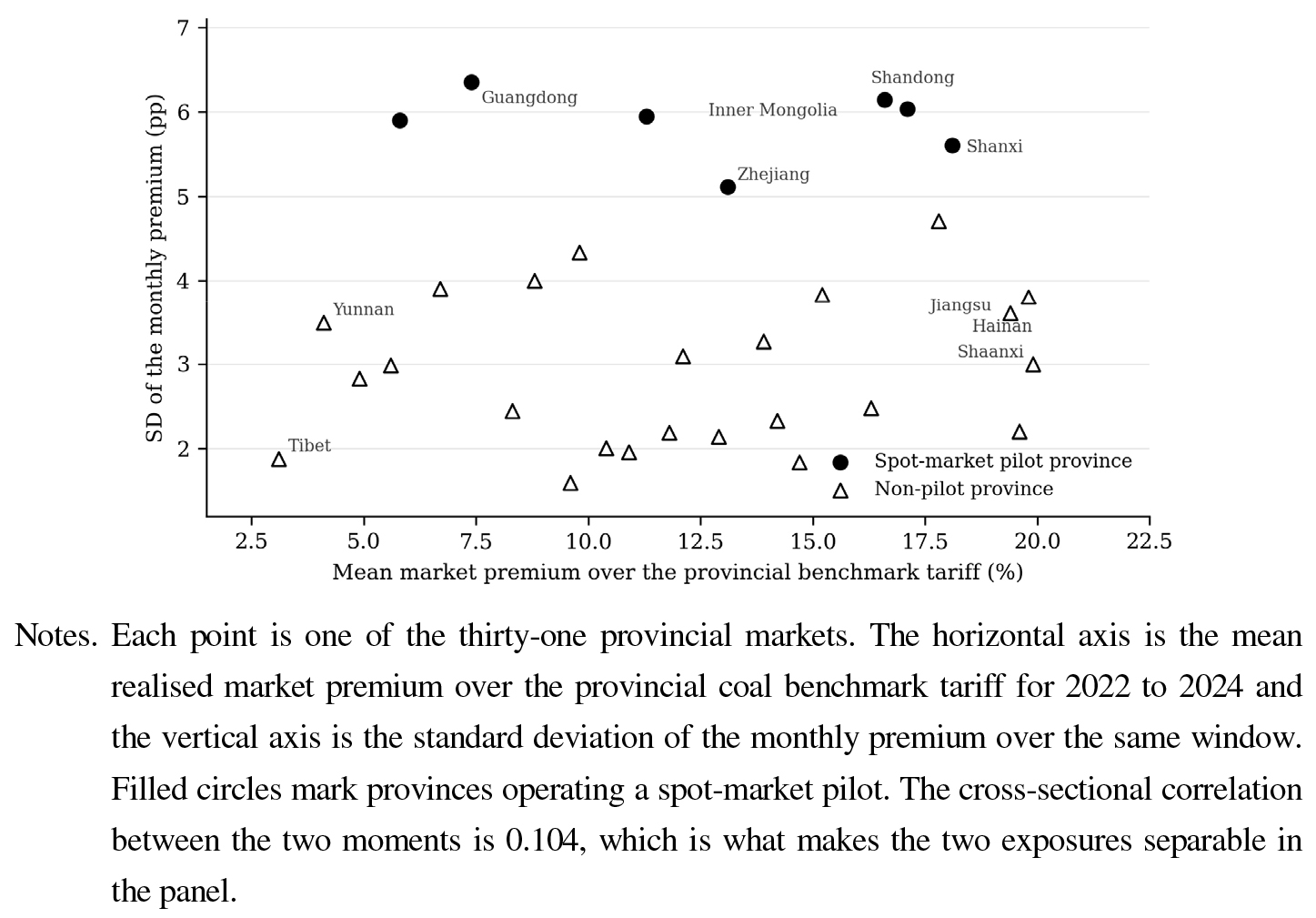
- On 12 October 2021 China’s National Development and Reform Commission widened the permitted trading band around the provincial coal-power benchmark tariff, abolished the industrial and commercial catalogue tariff, and exempted energy-intensive users from the upward cap. Chinese listed firms moved from an administered electricity price to a market price, and two properties of that price changed together: how high it was, and how predictable it was. Studies of energy price shocks generally treat a price change as a single treatment, which leaves open the question of which of the two properties the equity market responds to. We build both exposures from the same pre-reform measure of a firm’s pre-reform energy- cost intensity, one scaled by the level of the provincial market premium and one by its month-to-month variability, and enter them together. Exposure to variability shows the larger and more consistent association with the implied cost of equity; the association for exposure to the level is indistinguishable from zero in this design once the lower-order energy-intensity term is included. Where the level exposure does show up unambiguously is on the real side of the firm, in gross margins, in energy intensity and in energy-saving innovation, which is the adjustment margin the prior literature has documented. The risk coefficient is attenuated when realised cash-flow volatility is controlled for, consistent with that being one channel, and the association is markedly weaker among firms disclosing long-term bilateral power purchase agreements. The association survives when exposure is rebuilt from 2022 prices only, from the months observed up to each year, or from the spot-market pilot designation announced before the reform. In a conventional design that uses the administrative energy-intensive industry classification as the treated group, the post-reform difference is largely absorbed once the continuous exposures are introduced jointly, and the remaining association attaches to the variability of the price rather than to its level. Evaluations of price marketisation that consider only the average price therefore omit the dimension that is associated with the required return in this setting.
- COLLAPSE
2021년 10월 12일 중국 국가발전개혁위원회는 성(省)별 석탄화력 기준전가(基準電價)를 중심으로 한 거래 허용범위를 확대하고, 산업용·상업용 목록전가를 폐지하였으며, 에너지다소비 사용자에 대해서는 상한 규제를 면제하였다. 이로써 중국 상장기업은 행정가격 체제에서 시장가격 체제로 이행하였고, 그 과정에서 전력가격의 두 가지 성질, 즉 가격이 얼마나 높아졌는가와 얼마나 예측하기 어려워졌는가가 함께 변화하였다. 에너지 가격충격을 다룬 연구는 대체로 가격 변화를 하나의 처치로 취급해 왔으며, 그 결과 주식시장이 두 성질 가운데 무엇에 반응하는지는 규명되지 않은 채 남아 있다. 본 연구는 개혁 이전 기업의 에너지비용 의존도를 나타내는 동일한 지표에 성별 시장 프리미엄의 평균과 월별 변동성을 각각 결합하여 두 개의 노출도를 구성하고, 이를 함께 회귀식에 투입한다. 자기자본비용과 더 크고 더 일관된 관계를 보이는 것은 변동성 노출도이다. 수준 노출도의 관계는 약하며, 에너지집약도 하위차수 항을 포함하면 본 연구의 설계와 측정방식 하에서는 어떤 설정에서도 0과 구별되지 않는다. 수준 노출도가 뚜렷하게 나타나는 곳은 기업의 실물 측면, 즉 매출총이익률과 에너지집약도, 에너지절감 혁신이며 이는 선행연구가 밝혀 온 조정경로와 일치한다. 실현 현금흐름 변동성을 통제하면 위험 노출도의 계수가 약화되어 이를 하나의 경로로 보는 해석과 부합하며, 장기 양자 전력구매계약을 공시한 기업에서는 그 관계가 뚜렷하게 약하게 관찰된다. 위험 노출도의 관계는 2022년 가격정보만으로, 또는 각 연도까지 이용 가능한 정보만으로 노출도를 재구성하거나, 개혁 이전에 공표된 현물시장 시범지역 지정으로 실현 변동성을 대체하여도 유지된다. 행정적으로 지정된 에너지다소비 업종을 처치집단으로 삼는 통상적 설계는 연속 노출도가 주로 가격의 변동성에 귀속시키는 관계를 가격의 수준에 귀속시킨다. 따라서 가격 시장화의 후생 평가는 가격의 수준에서 멈출 경우 불완전하다.
-
Price Level, Price Risk, and the Cost of Equity: Evidence from the Marketisation of China’s Coal-Power Tariff
-
Research Article
-
Decomposing Energy Inefficiency in Non-Residential Buildings Using Hourly Electricity Data: A Frontier Analysis of Operational and Structural Efficiency
시간별 전기소비 자료를 이용한 비주거 건물의 에너지 비효율 분해: 운영효율과 구조효율의 프런티어 분석
-
Giseon Kim, Jongwoo Kim, Sangkyu Park
김기성, 김종우, 박상규
- Improving electricity efficiency in the building sector requires more than identifying high-consuming buildings, because observed consumption reflects not only unavoidable demand drivers—scale, …
건물 부문의 전력효율 개선은 소비량이 많은 건물을 선별하는 것만으로는 이루어지기 어렵다. 관측된 소비에는 규모・용도・기상・재실과 같은 불가피한 수요요인과 함께 설비・외피의 특성 및 운영형태가 …
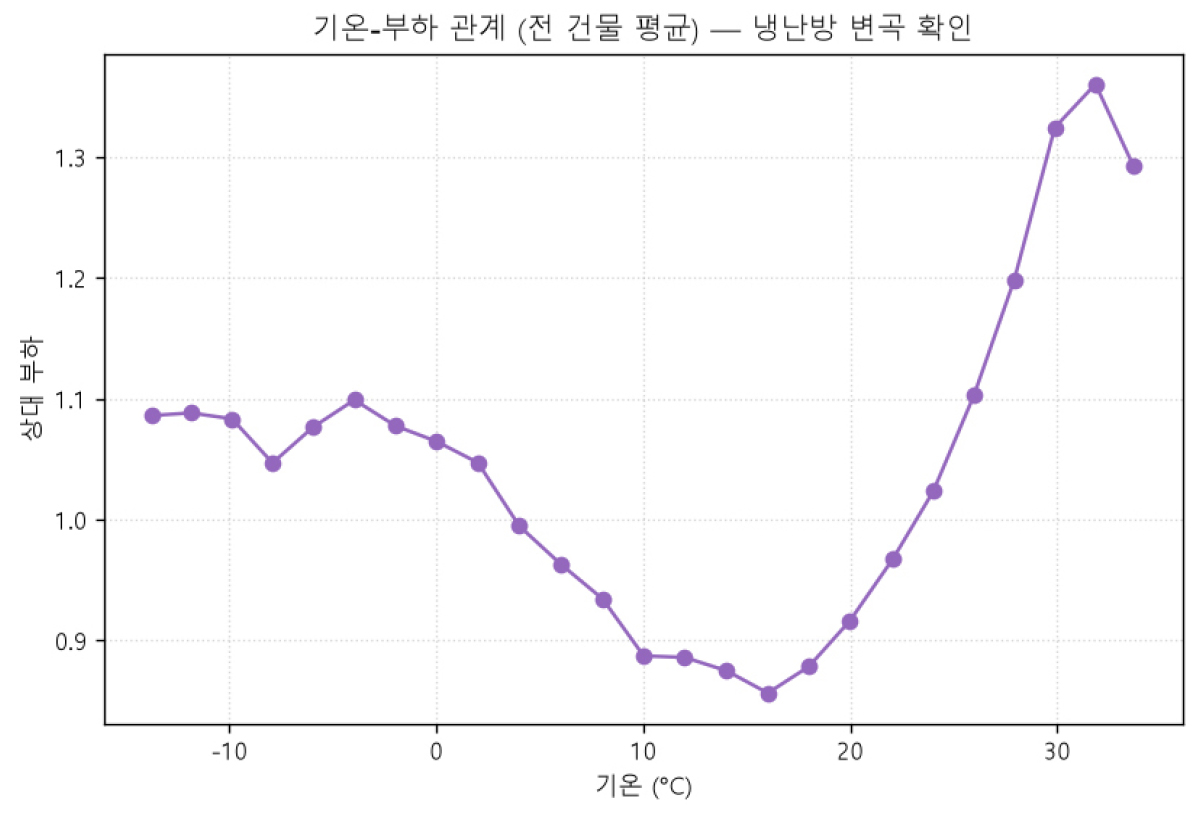
- Improving electricity efficiency in the building sector requires more than identifying high-consuming buildings, because observed consumption reflects not only unavoidable demand drivers—scale, use type, weather, and occupancy—but also the characteristics of the envelope and equipment and the way buildings are operated. Annual aggregate indicators therefore obscure the magnitude, source, and timing of inefficiency. This study assembles a balanced panel of 186 non-residential public buildings in Korea (office, education/research, assembly, and medical uses) for 2022, combining hourly electricity consumption, building-specific weather data, and the Energy Consumption Survey microdata (1,629,360 observations). We sequentially apply three frontier approaches—a conditional minimum-demand frontier based on change-point quantile regression, a four-component stochastic frontier, and a load-shape frontier—to decompose building energy inefficiency into operational and structural dimensions. Relative to the conditional minimum load attainable under identical weather, time-of-day, and operating states, excess consumption is estimated at 22.8% of total sample consumption and is concentrated in weekday daytime operating hours. The correlation between annual aggregate efficiency and hourly operational efficiency is only 0.19, confirming that annual indicators fail to capture time-varying operational inefficiency. Decomposing inefficiency into persistent (structural) efficiency (PE) and transient (operational) efficiency (TE), the two frontier approaches converge at a rank correlation of 0.833, and the realizable operational saving—after separating noise—is bounded within 181-301 GWh per year. An exploratory cluster analysis on the two efficiency scores classifies the sample into an efficient group (66%), an operation-improvement group (13%), and a structure- improvement group (21%); buildings that are simultaneously low on both dimensions are virtually absent, so a single prescription applies to most buildings. The groups are distinguished not by building size or vintage but by load shape and consumption intensity. These findings suggest a shift from uniform efficiency support toward diagnosis-based differentiated support, the institutionalization of operational improvement prior to capital investment in equipment, and the separation of aggregate energy saving and peak management as distinct policy objectives.
- COLLAPSE
건물 부문의 전력효율 개선은 소비량이 많은 건물을 선별하는 것만으로는 이루어지기 어렵다. 관측된 소비에는 규모・용도・기상・재실과 같은 불가피한 수요요인과 함께 설비・외피의 특성 및 운영형태가 반영되어 있어, 연간 총량 지표만으로는 비효율의 크기와 원인, 발생 시점을 구분하기 어렵기 때문이다. 본 연구는 업무・교육연구・문화집회・의료 용도의 국내 비주거 건물 186개동을 대상으로 2022년 시간별 전력소비, 건물별 기상자료, 에너지총조사 자료를 결합한 균형패널을 구축하고, 조건부 최소수요 프런티어(변화점 분위수회귀), 4-성분 확률 프런티어, 부하형상 프런티어를 단계적으로 적용하여 건물 에너지 비효율을 운영적 차원과 구조적 차원으로 분해한다. 분석 결과, 동일한 기상・시간대・운영상태에서 달성 가능한 조건부 최소부하 대비 초과소비는 표본 전체 소비량의 22.8%로 추정되었으며, 주로 평일 주간 영업시간대에 집중되었다. 연간 총량효율과 시간 단위 운영효율의 상관은 0.19에 그쳐, 연간 지표만으로는 시간대별 운영 비효율을 포착하기 어려움을 확인하였다. 비효율을 구조효율(PE)과 운영효율(TE)로 분해한 결과 두 프런티어 접근의 순위상관은 0.833으로 나타났고, 잡음을 제거한 실현 가능 운영 절감 잠재량은 연간 약 181 GWh로 도출되었다. 두 효율지표를 이용한 탐색적 군집분석은 표본을 효율 양호군(66%), 운영개선 대상군(13%), 구조개선 대상군(21%)으로 유형화하였으며, 구조효율과 운영효율이 동시에 낮은 유형은 관측되지 않아 표본건물별로 우선 검토할 개선 방향을 구분할 수 있었다. 유형을 구분하는 요인은 건물의 규모나 연식이 아니라 부하형상과 소비강도였다. 이러한 결과는 일괄적 효율지원에서 비효율의 원인에 따른 진단 기반 차등지원으로의 전환, 설비투자에 선행하는 운영개선의 제도화와 그린버튼 플랫폼을 통한 지속적 관리가 필요함을 시사한다.
-
Decomposing Energy Inefficiency in Non-Residential Buildings Using Hourly Electricity Data: A Frontier Analysis of Operational and Structural Efficiency
-
Research Article
-
Price Formation of Biomethane Certificates: Comparisons of U.S. and European Schemes and Their Implications
바이오가스 기반 바이오메탄 인증서의 가격형성 원리: 미국・유럽 제도 비교와 시사점
-
Taesik Kim
김태식
- This study examines biomethane production and certificate prices when each certificate can be used only once, either for compliance or a voluntary …
이 연구는 동일한 인증서를 의무이행과 자발적 사용 주장 중 하나에만 최종 사용하는 시장에서 바이오메탄의 생산량과 인증서 가격을 정태 부분균형모형으로 분석한다. 경쟁적 거래와 …
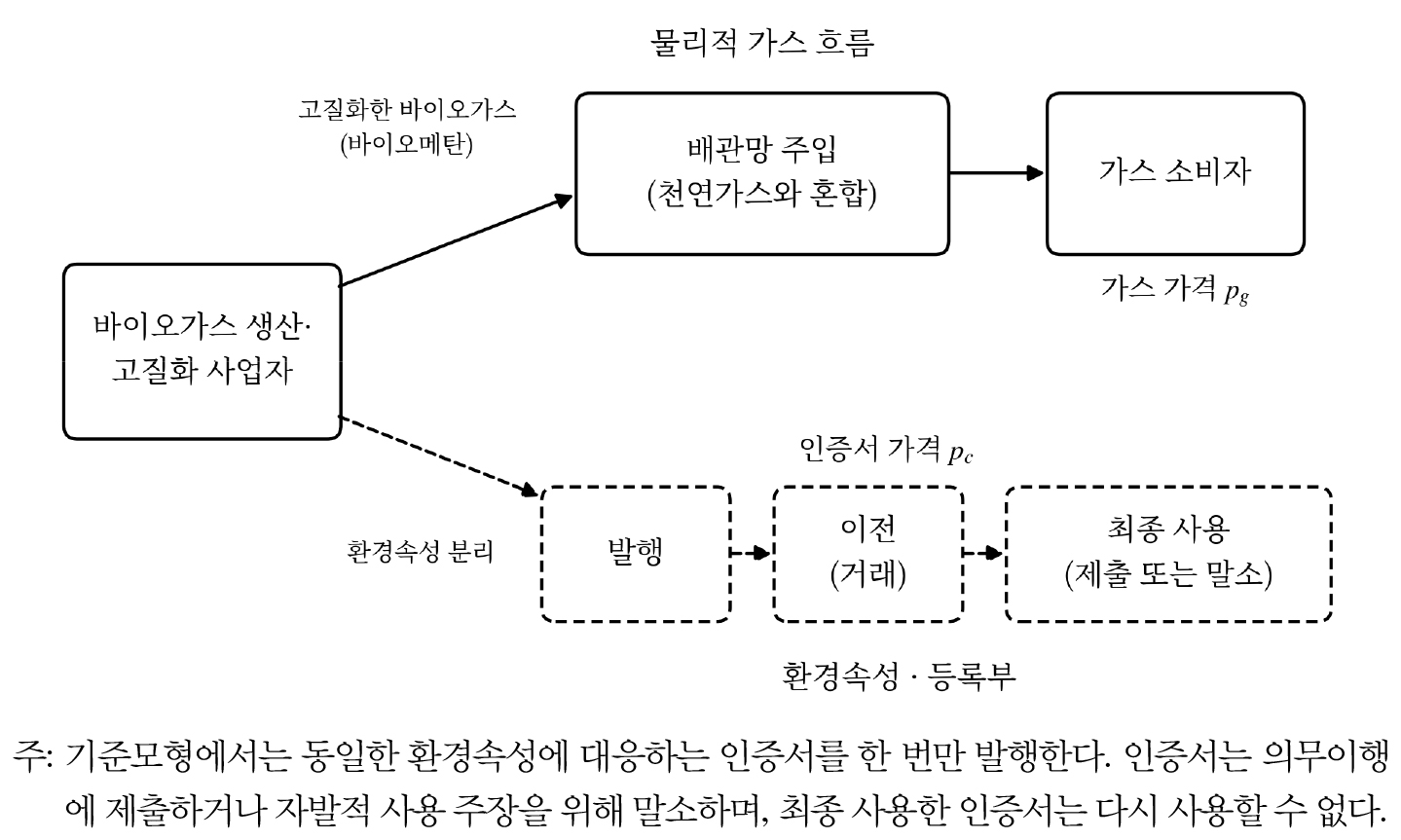
- This study examines biomethane production and certificate prices when each certificate can be used only once, either for compliance or a voluntary claim. A static partial-equilibrium model assumes competitive trading and an exogenous natural-gas netback and distinguishes four regimes: zero certificate prices, coexistence of compliance and voluntary demand, compliance demand alone, and alternative compliance. When certificate prices lie strictly between zero and the alternative-compliance price and capacity is nonbinding, they equal marginal production costs net of gas revenue and the shadow price of the compliance constraint. In the coexistence regime without a binding capacity constraint, an increase in obligations raises production and displaces voluntary purchases; total displacement cannot exceed initial voluntary demand. Production responses differ when voluntary demand vanishes, unused quantities remain, or alternative compliance is used. Comparisons of U.S. and European schemes highlight the importance of the unit and final use of rights, alternative compliance, and banking for interpreting prices. Application to Korea requires distinguishing biogas production credits from biomethane environmental attributes and examining their relationship and conditions of use.
- COLLAPSE
이 연구는 동일한 인증서를 의무이행과 자발적 사용 주장 중 하나에만 최종 사용하는 시장에서 바이오메탄의 생산량과 인증서 가격을 정태 부분균형모형으로 분석한다. 경쟁적 거래와 외생적 순가스가격 아래에서 가격 0, 두 수요의 공존, 의무수요만의 존재, 대체이행 사용으로 균형을 구분한다. 가격이 0과 대체이행 단가 사이에 있고 공급상한이 구속하지 않으면 인증서 가격은 순가스 판매수입으로 회수되지 않는 한계비용이자 의무이행 제약의 잠재가격이다. 공급상한이 구속하지 않는 공존구간에서는 의무 확대가 생산 증가와 자발적 구매 감소로 나뉘며, 구매 감소량은 초기 자발적 수요를 넘지 못한다. 자발적 수요가 소멸하거나 잉여・대체이행이 존재하면 생산반응은 달라진다. 미국・유럽 제도 비교는 권리의 표시단위와 최종 사용, 대체이행・이월 조건이 가격 해석에 중요함을 보여준다. 국내 적용에서는 바이오가스 생산실적과 바이오메탄 환경속성의 구별을 바탕으로 두 권리의 관계와 사용조건을 검토할 필요가 있다.
-
Price Formation of Biomethane Certificates: Comparisons of U.S. and European Schemes and Their Implications
-
Research Article
-
Decomposing CO₂ Emission Changes in the Power Sectors of Korea and Japan
한국과 일본 전력부문의 이산화탄소 배출 변화요인 비교분석
-
Hyemin Lee, Soocheol Lee, Yongsung Cho
이혜민, 이수철, 조용성
- This study combines additive Logarithmic Mean Divisia Index (LMDI) decomposition with Tapio’s decoupling index (DI) to analyze changes in CO₂ emissions from …
본 연구는 가법적 로그평균 디비지아 지수(Logarithmic Mean Divisia Index) 분해분석과 Tapio의 탈동조화지수(Decoupling Index)를 결합하여 2013년부터 2023년까지 한국과 일본 전력부문의 CO₂ 배출량 변화를 …
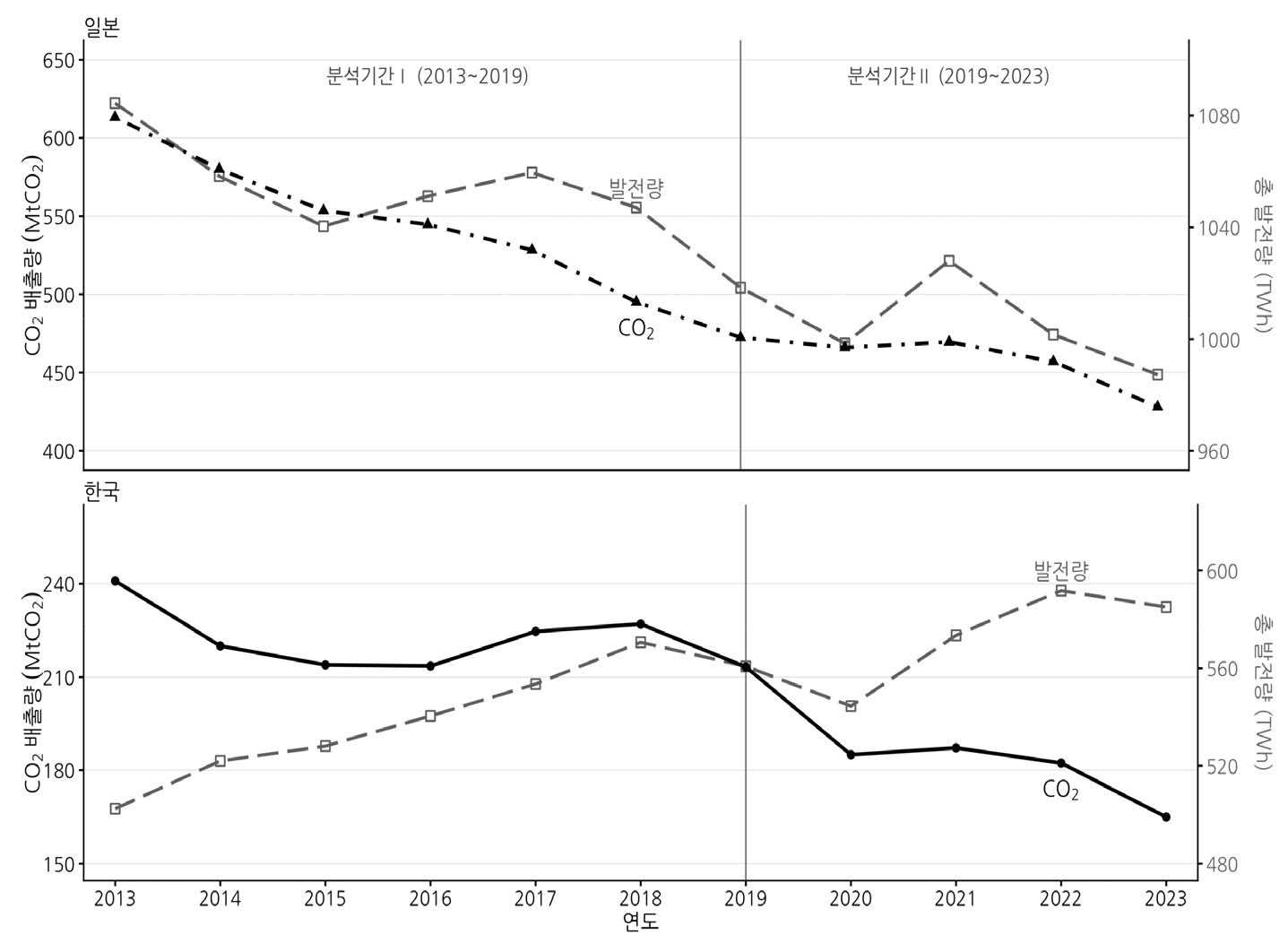
- This study combines additive Logarithmic Mean Divisia Index (LMDI) decomposition with Tapio’s decoupling index (DI) to analyze changes in CO₂ emissions from the power sectors of Korea and Japan from 2013 to 2023. Changes in CO₂ emissions are decomposed into seven factors: emission coefficient, generation efficiency, fossil generation mix, nuclear power, renewable energy, electricity intensity, and economic activity. The contributions of renewable energy and nuclear power are separately quantified using a complement-based approach. The results show that power-sector CO₂ emissions declined in both countries, although the main drivers of emission reductions differed. In Korea, the generation efficiency effect was the largest contributor to emission reductions, whereas in Japan, the electricity intensity effect was the largest. Renewable energy and nuclear power also contributed to emission reductions in both countries. The decoupling analysis shows that Korea experienced strong decoupling, with total electricity generation increasing while CO₂ emissions declined, whereas Japan exhibited recessive decoupling, with both total electricity generation and CO₂ emissions decreasing. These findings demonstrate that Korea and Japan have followed different pathways of power-sector decarbonization and provide implications for decarbonization policies and comparative research in East Asia.
- COLLAPSE
본 연구는 가법적 로그평균 디비지아 지수(Logarithmic Mean Divisia Index) 분해분석과 Tapio의 탈동조화지수(Decoupling Index)를 결합하여 2013년부터 2023년까지 한국과 일본 전력부문의 CO₂ 배출량 변화를 분석하였다. CO₂ 배출량 변화는 배출계수, 발전효율, 화력발전 구조, 원자력발전, 재생에너지발전, 전력집약도 및 경제활동의 7개 요인으로 분해하였다. 또한 재생에너지와 원자력발전의 기여도는 보완항 방식을 이용하여 각각 분리하여 정량화하였다. 분석 결과, 양국 모두 전력부문 CO₂ 배출량이 감소하였으나 주요 감축 요인은 상이하였다. 한국에서는 발전효율 변화 효과가, 일본에서는 전력집약도 효과가 가장 큰 감축 요인으로 나타났으며, 재생에너지와 원자력발전 역시 배출 감소에 기여하였다. 탈동조화 분석에서는 한국이 총발전량 증가와 배출 감소가 동시에 나타나는 강한 탈동조화, 일본은 총발전량과 배출량이 함께 감소하는 쇠퇴적 탈동조화 상태를 보였다. 이러한 결과는 한국과 일본이 서로 다른 전력부문 탈탄소화 경로를 밟아왔음을 보여주며, 동아시아의 탈탄소화 정책 및 비교연구에 시사점을 제공한다.
-
Decomposing CO₂ Emission Changes in the Power Sectors of Korea and Japan
-
Research Article
-
A Study on the Suitability Evaluation and Reclassification of Projects for the Electric Power Industry Basis Fund
전력산업기반기금 사업으로서의 적격성 평가 및 재분류 연구: 에특회계, 기후대응기금, 한전 자체 공익사업을 중심으로
-
Daeyoun Lee, Sung-Jin Cho, SeoJong Kang
이대연, 조성진, 강서종
- The Electric Power Industry Basis Fund was established in the early 2000s, following the restructuring of Korea’s electric power industry, to ensure …
전력산업기반기금은 2000년대 초반 전력산업 구조개편에 따라 기존에 한전에서 자체 재원으로 수행하던 공익사업들을 지속적으로 수행하기 위해 별도로 조성된 기금이다. 지난 20여 년간 전력산업기반기금은 …
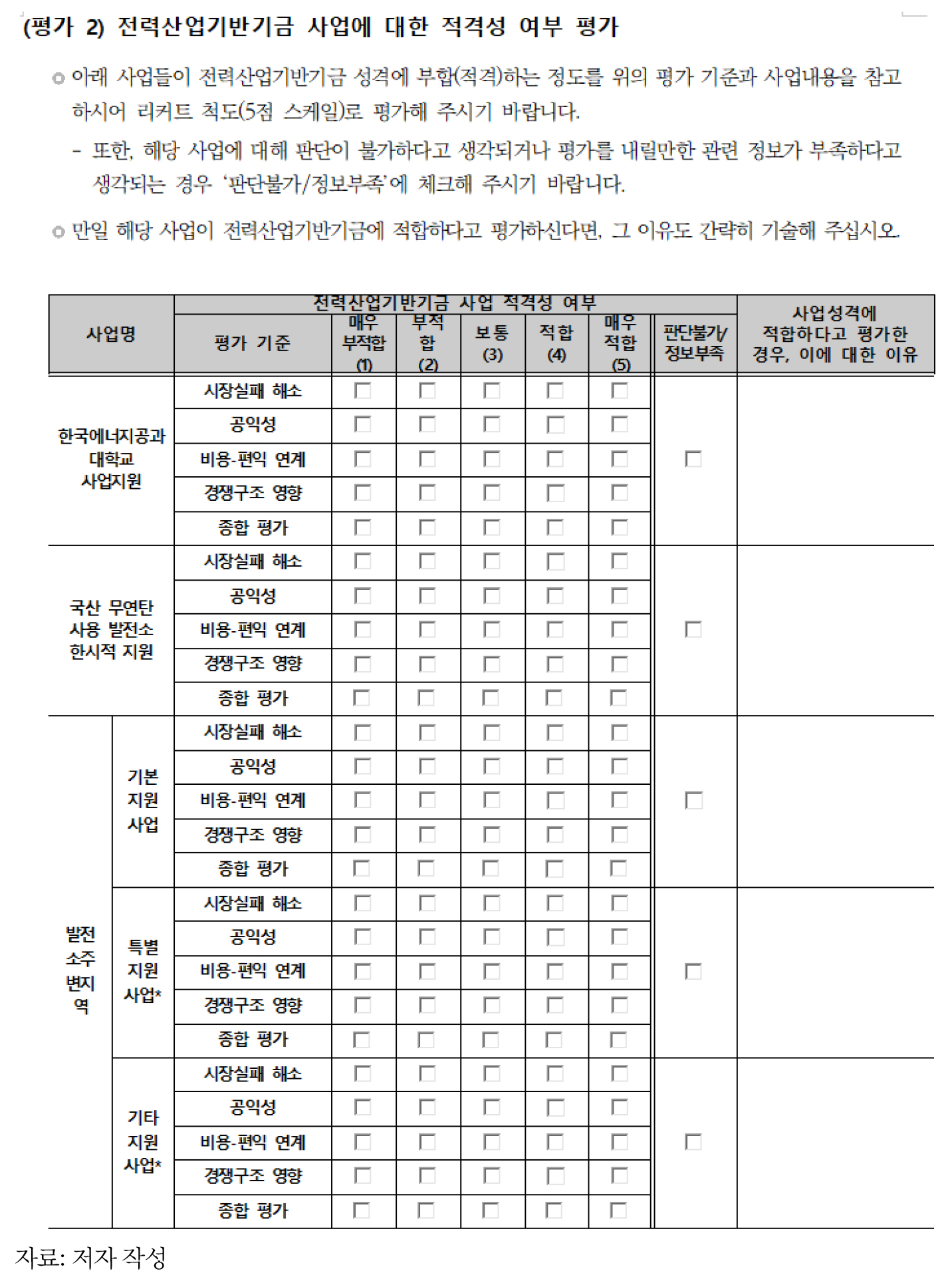
- The Electric Power Industry Basis Fund was established in the early 2000s, following the restructuring of Korea’s electric power industry, to ensure the continuity of public-interest programs previously financed and administered by the Korea Electric Power Corporation (KEPCO). Over the past two decades, the Fund has supported both power industry development and various public-interest initiatives. Recently, however, concerns have been raised regarding the diminished public-interest relevance of certain Fund-supported programs and their potential overlap with other energy-related fiscal programs.This study develops evaluation criteria to assess project suitability for the Electric Power Industry Basis Fund. Applying these criteria, it evaluates programs funded by the Fund, the Special Account for Energy and Resources, the Climate Response Fund, and KEPCO's own public-interest initiatives. Based on this assessment, the study identifies suitable programs for the Fund and proposes strategic directions for restructuring its project portfolio. Furthermore, expert opinions were gathered to enhance the validity and reliability of the proposed alternatives.
- COLLAPSE
전력산업기반기금은 2000년대 초반 전력산업 구조개편에 따라 기존에 한전에서 자체 재원으로 수행하던 공익사업들을 지속적으로 수행하기 위해 별도로 조성된 기금이다. 지난 20여 년간 전력산업기반기금은 전력사업 발전과 공익적 사업에 활용되어 왔으나, 최근 공익성이 약화되었다는 지적과 함께 유사 에너지 재정사업과의 유사·중복성 문제도 제기되고 있다. 이에 본 연구에서는 전력산업기반기금 사업 적격성 평가기준을 마련하고 이를 바탕으로 전력산업기반기금과 에특회계, 기후대응기금, 한전 자체 공익사업 등을 대상으로 전력기반기금 사업으로의 적합 여부를 식별하고 재편방향을 도출하였다. 또한, 도출된 재편 방향에 대해 전문가들의 의견을 수렴함으로써 도출된 대안의 타당성과 신뢰성을 확보하였다. 본 연구에서 도출된 전력기금 적격성 평가 기준과 재편방향은 향후 에너지 공익사업 재편 논의에 기초자료로서 주요하게 활용될 수 있을 것이다.
-
A Study on the Suitability Evaluation and Reclassification of Projects for the Electric Power Industry Basis Fund

 Korean Energy Economic Review