Research Article


Alberola, E., Chevallier, J., Chèze, B. (2008). The EU emissions trading scheme: The effects of industrial production and CO2 emissions on carbon prices. Economie Internationale, 116(4), 93-125.
10.2139/ssrn.1133139Benz, E., Trück, S. (2009). Modeling the price dynamics of CO2 emission allowances. Energy Economics, 31(1), 4-15.
10.1016/j.eneco.2008.07.003Bolton, P., Kacpercyk, M. (2021). Do investors care about carbon risk?. Journal of Financial Economics, 142, 517-549.
10.1016/j.jfineco.2021.05.008Chapple, L., Clarkson, P. M., Gold, D. L. (2013). The cost of carbon: Capital market effects of the proposed emissions trading scheme (ETS). Abacus, 49, 1-33.
10.1111/abac.12006Choi, Y., Liu, Y., Lee, H. (2017). The economy impacts of Korean ETS with an emphasis on sectoral coverage based on a CGE approach. Energy Policy, 109, 835-844.
10.1016/j.enpol.2017.06.039Dechezleprêtre, A., Gennaioli, C., Martin, R., Muûls, M., Stoerk, T. (2022). Searching for carbon leaks in multinational companies. Journal of Environmental Economics and Management, 112, 102601.
10.1016/j.jeem.2021.102601Fang, Z., Chen, Y. (2017). Human capital and energy in economic growth-Evidence from Chinese provincial data. Energy Economics, 68, 340-358.
10.1016/j.eneco.2017.10.007ICAP. (2015.01.08). Korea’s Emissions Trading System started on 1 January 2015. ICAP. https://icapcarbonaction.com/en/news/koreas-emissions-trading-system-started-1-january-2015?utm_source=chatgpt.com
Khue, P. M., Lee, J., Park, H. (2024). The effects of carbon emissions trading on environmental and financial performance: Evidence from Korean listed firms. Journal of International Financial Management & Accounting, 35(3), 760-799.
10.1111/jifm.12211La Hoz Theurer, S., Ortiz Rivera, V., Biedenkopf, K. (2025). ETS, Reloaded? Designing Emissions Trading for Net-Zero and Net-Negative Societies. ICAP. https://icapcarbonaction.com/en/publications/ets-reloaded-designing-emissions-trading-net-zero-and-net-negative-societies
Legal Response International. (2025.02.03.). Carbon Trading Schemes Around the World. Legal Response International. https://legalresponse.org/resource/carbon-trading-schemes-around-the-world/
Millischer, L., Evdokimova, T., Fernandez, O. (2023). The carrot and the stock: In search of stock-market incentives for decarbonization. Energy Economics, 120, 106615.
10.1016/j.eneco.2023.106615Narassimhan, E., Gallagher, K. S., Koester, S., Alejo, J. R. (2018). Carbon pricing in practice: A review of existing emissions trading systems. Climate Policy, 18, 967-991.
10.1080/14693062.2018.1467827Oberndorfer, U. (2009). EU emission allowances and the stock market: evidence from the electricity industry. Ecological Economics, 68(4), 1116-1126.
10.1016/j.ecolecon.2008.07.026Oestreich, A. M., Tsiakas, I. (2015). Carbon emissions and stock returns: Evidence from the EU Emissions Trading Scheme. Journal of Banking & Finance, 58, 294-308.
10.1016/j.jbankfin.2015.05.005Park, H., Hong, W. K. (2014). Korea׳ s emission trading scheme and policy design issues to achieve market-efficiency and abatement targets. Energy Policy, 75, 73-83.
10.1016/j.enpol.2014.05.001Park, H., Khue, P. M., Lee, J. (2024). The effects of carbon emissions trading on profitability and value: Evidence from Korean listed firms. Journal of International Financial Management & Accounting, 35, 760-799.
10.1111/jifm.12211- Publisher :Korea Energy Economic Institute·Korea Resource Economics Association
- Publisher(Ko) :에너지경제연구원·한국자원경제학회
- Journal Title :Korean Energy Economic Review
- Journal Title(Ko) :에너지경제연구
- Volume : 25
- No :1
- Pages :65-116
- Received Date : 2026-01-25
- Revised Date : 2026-03-16
- Accepted Date : 2026-03-16
- DOI :https://doi.org/10.22794/keer.2026.25.1.003
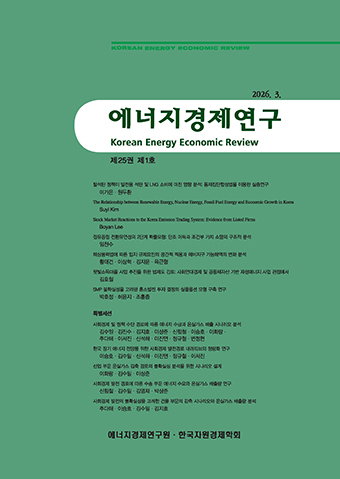 Korean Energy Economic Review